
Most small businesses in Sri Ganganagar buy ads first and ask questions later. Then a few enquiries trickle in, nobody knows why, and the budget disappears. A marketing funnel fixes that, because it shows you where people find you, where they hesitate and where they leave.
So, how do you build one? Set one goal, learn who your customer is, map four stages, pick a channel for each stage, build the pages and follow-ups, hand leads to sales and count the results every week. Below, you will see each step in plain words, a local example and a table you can copy into a notebook or Google Sheet. If you still wonder whether the effort is worth it, read how digital marketing helps businesses grow first.
What a marketing funnel needs before you build it
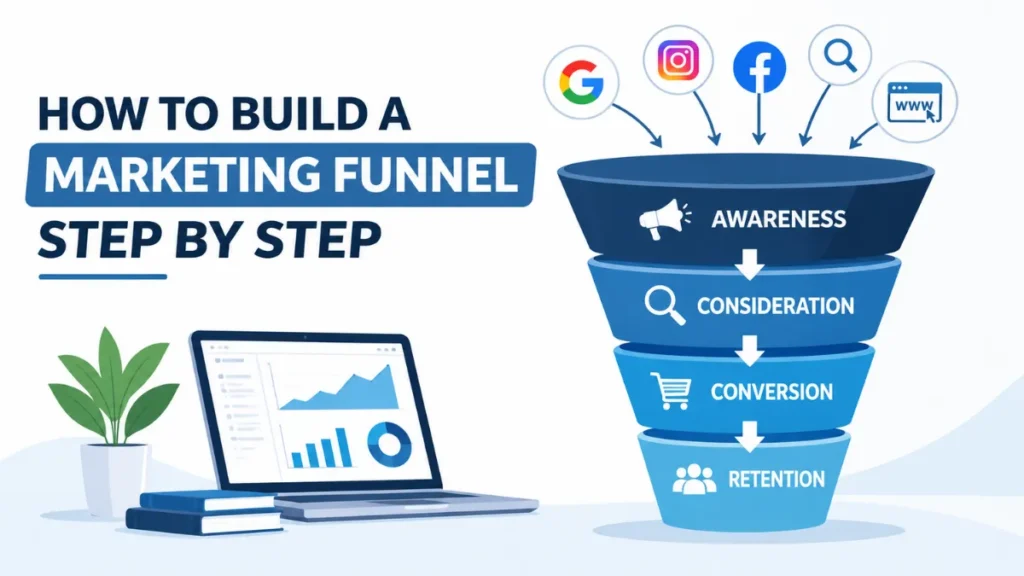
Every funnel has four stages. People notice you, compare you, buy from you and then come back. Marketers call the first three the top, middle and bottom of the funnel (TOFU, MOFU and BOFU). The table shows what each stage looks like in practice.
| Stage | What the customer thinks | What you provide | What you count |
| Awareness | “Who are you?” | Google listing, Reels, search content | Reach and visits |
| Consideration | “Is this right for me?” | Reviews, FAQs, demos | Enquiries |
| Conversion | “I’m ready to buy.” | A clear offer and a fast reply | Sales |
| Retention | “Was it worth it?” | Reminders and a review request | Repeat orders |
Our guide on what a funnel in marketing is explains each stage in detail, so we will skip the theory here. Instead, let’s build.
How to build a marketing funnel step by step
You do not need paid software. A notebook and a phone work well for the first three months.
1. Set one goal and one number
Pick one result for the next 90 days. For example, a coaching institute may want 25 admissions, and a sweet shop may want 40 festival orders a week. Write that number on the first page of your notebook. Otherwise, every idea looks useful, and you end up doing ten things badly.
2. Learn who you are building for
Describe one real customer, not a crowd. A tractor dealer, for instance, sells to a farmer who asks his brother and visits two showrooms before he pays. So the funnel needs a call and a test drive, not just a Facebook ad. Ask your last ten buyers three questions: where did you first see us, what made you hesitate, and what pushed you to buy? Their answers beat any persona template.
3. Map the stages with real questions
Write what the customer asks at each stage, then write the page or message that answers it. A parent asks “Is this institute any good?” during consideration, so results, reviews and a demo class answer that doubt. If you cannot name an answer, you have found a gap. Fix it before you pick a channel.
4. Pick one or two channels per stage
Do not use every channel at once. Instead, match each stage to the pillars that fit it: SEO, social media and ads for awareness, content and email for consideration, and a landing page with WhatsApp for conversion. Our guide to the pillars of digital marketing explains how each one works. In Sri Ganganagar, a complete Google Business Profile and one Instagram account already cover awareness for most shops. Then add a third channel only when the first two run smoothly.
5. Build the pages and follow-ups
Now make the assets. Create one landing page with one call to action, such as “Book a free demo” or “Message us on WhatsApp.” Next, write three follow-up messages: one that answers the biggest doubt, one with proof, and one with a deadline. Also add UTM tags to your links, because they show which post or ad brought each enquiry. Meanwhile, keep posting, and a social media calendar makes that easy.
6. Set the handoff, then count every week
A lead is anyone who asks you for something, such as a price, a demo, a call or a visit. The moment that happens, sales takes over. So set a reply time, like one hour during working hours, and keep it. Then count three numbers each week: enquiries, replies within your promised time and sales. Our post on marketing funnel vs sales funnel shows where one ends and the other starts. In short, fix the weakest number first.
Marketing funnel example: a dental clinic in Sri Ganganagar
Picture a dental clinic in the city. The numbers below are made up to show the logic, so please do not treat them as benchmarks.
| Stage | What happens | People each month |
| Awareness | People find the clinic on Google Maps and Instagram | 1,500 |
| Consideration | They call or message on WhatsApp | 90 |
| Conversion | They book an appointment | 18 |
Only 20 percent of enquiries turned into bookings. The owner’s first idea was more ads. However, a quick look at the phone showed that WhatsApp messages sent after 6 pm waited until the next afternoon. By then, those patients had called another clinic.
So the owner set an auto-reply with the fee range and a booking link, and started answering within one hour. The next month, bookings rose from 18 to 36 from the same 1,500 people. Doubling the traffic would have needed 3,000 views and a bigger ad bill. After each visit, a six-month recall message and a review request keep the funnel running.
Marketing funnel template you can copy
Copy this table into a notebook or Google Sheet, then adjust the wording to match your business.
| Stage | Customer question | Your answer | Channel | Number to track | Owner |
| Awareness | Who are you? | Google listing, Reel, helpful post | Google, Instagram | Profile views | You |
| Consideration | Is this right for me? | Reviews, FAQ, demo | Website, WhatsApp | Enquiries | You |
| Conversion | Can I buy it easily? | Clear offer, quick quote | WhatsApp, phone call | Sales | You |
| Retention | Should I come back? | Reminder, review request | WhatsApp, email | Repeat orders | You |
Keep it to four rows. Extra stages add detail, but they rarely change what you do on Monday morning.
Common mistakes when you build a funnel
- Building for everyone. A funnel for “all customers” speaks to nobody, so pick one buyer first.
- Buying traffic before fixing replies. Slow answers waste every rupee you spend on reach.
- Adding too many stages. Four stages are enough to act on.
- Skipping the call to action. Every page needs one clear next step.
- Never counting. Without numbers, you guess where the leak sits.
FAQ
How do I build a marketing funnel from scratch?
Set one goal, learn your customer, map four stages, pick one or two channels per stage, build the pages and follow-ups, then count the results weekly.
How many stages should a marketing funnel have?
Four work for most small businesses: awareness, consideration, conversion and retention. More stages add detail, but they rarely change your actions.
What is a funnel in digital marketing?
It is the same customer path, tracked online, so you can count visits, enquiries and sales at each stage.
Do I need funnel software?
No. A notebook or Google Sheet works well until you handle many leads every day. At that point, a simple CRM helps.
How long does a funnel take to work?
You usually see where people drop out within the first month. SEO and content results, however, build over several months.
Your takeaway
Open a sheet today and write three numbers from last month: enquiries, replies within one hour and sales. If the second number looks low, fix that before you pay for another ad. Then repeat the count every Friday.