
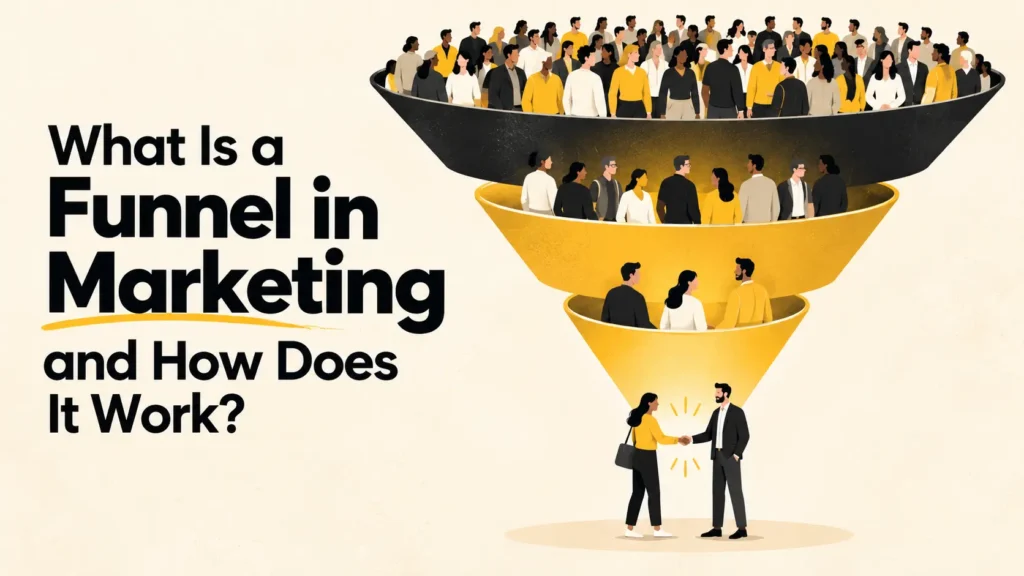
Quick answer: A marketing funnel is a model of how a stranger becomes a customer. It has four stages: awareness, consideration, conversion and retention. It looks like a funnel because fewer people move forward at each stage, so the top is wide and the bottom is narrow. Marketers also call the stages top of the funnel (TOFU), middle of the funnel (MOFU) and bottom of the funnel (BOFU).
Say a digital marketing coaching institute in Sri Ganganagar gets 1,000 website visitors a month and 6 admissions. Is that good or bad? You can’t tell until you see where the other 994 people dropped out. A funnel shows you, and we’ll come back to this institute in a minute.
What is a funnel in marketing?
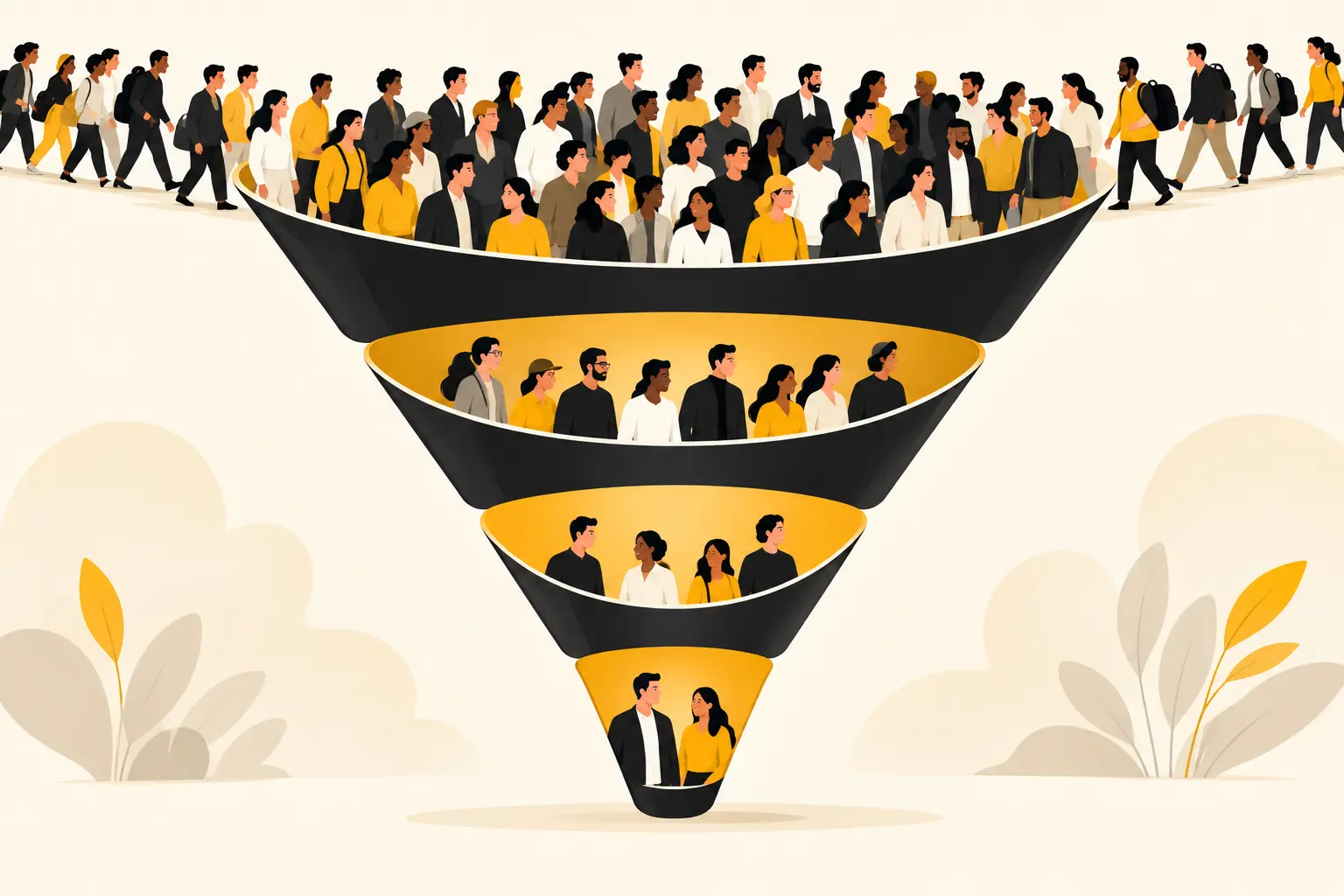
A funnel is a simple picture of the path from “never heard of you” to “I’ll buy”. Lots of people enter at the top, and only a few reach the bottom. Marketers call that narrowing the funnel effect, and it’s normal. Nobody expects everyone who watches a Reel to buy.
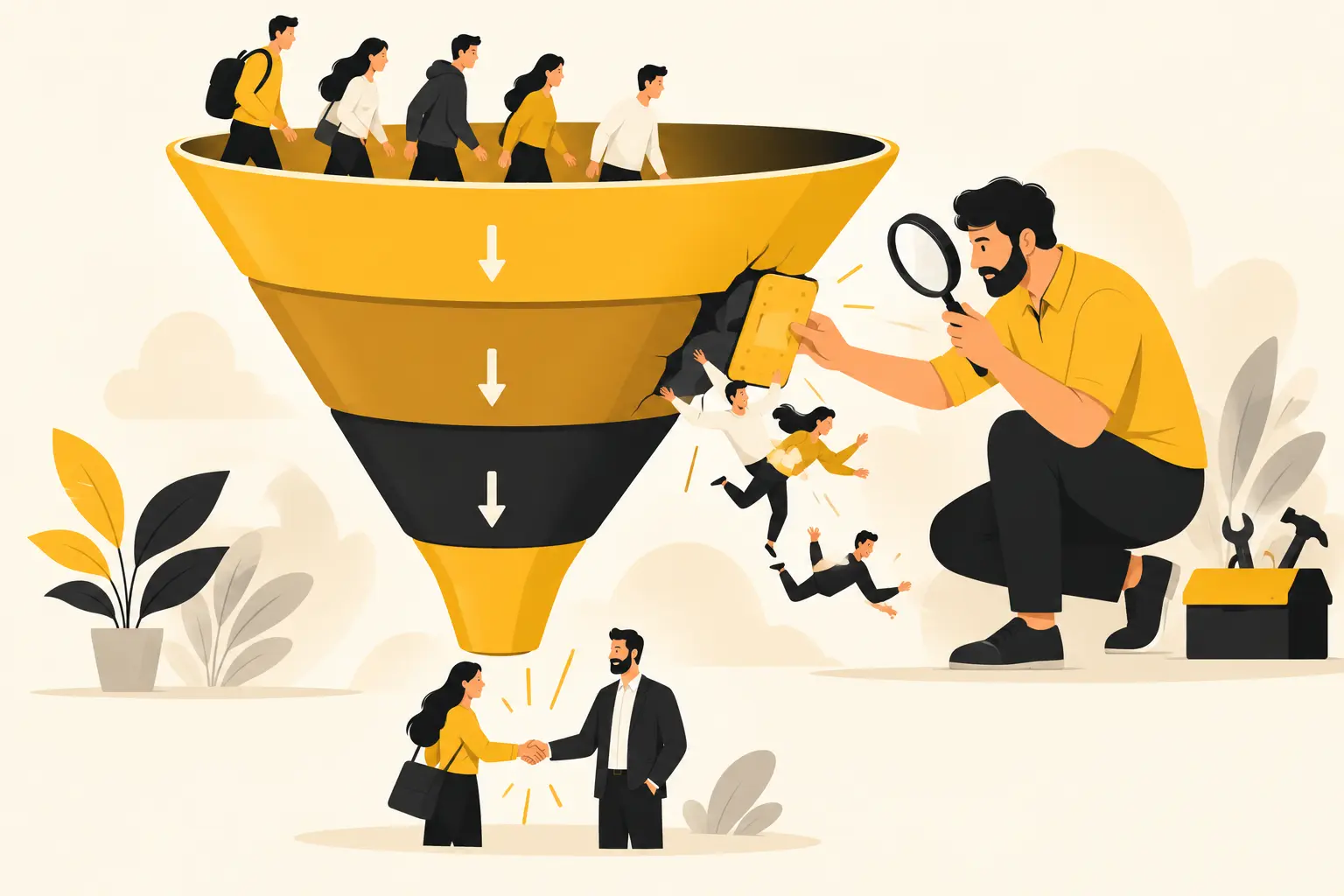
The point isn’t to stop the narrowing. It’s to see where you lose people and why. In digital marketing, you can count people at every step: views, clicks, enquiries, sales. So the funnel stops being a drawing and becomes a set of numbers you can act on.
Why do you need a marketing funnel?
Without one, you tend to fix the wrong thing. A tractor dealer who gets plenty of inquiries but few sales doesn’t need more ads. The leak sits lower down, maybe in how fast someone calls back. A funnel gives you three things:
- A leak finder. You see which stage loses the most people.
- The right message at the right moment. A new visitor doesn’t want a price list, and a ready buyer doesn’t want your life story.
- A smarter budget. You spend where the weakest stage is, not where it’s easiest to spend.
If you’re still deciding whether the effort is worth it, read how digital marketing helps businesses grow.
The stages of the marketing funnel
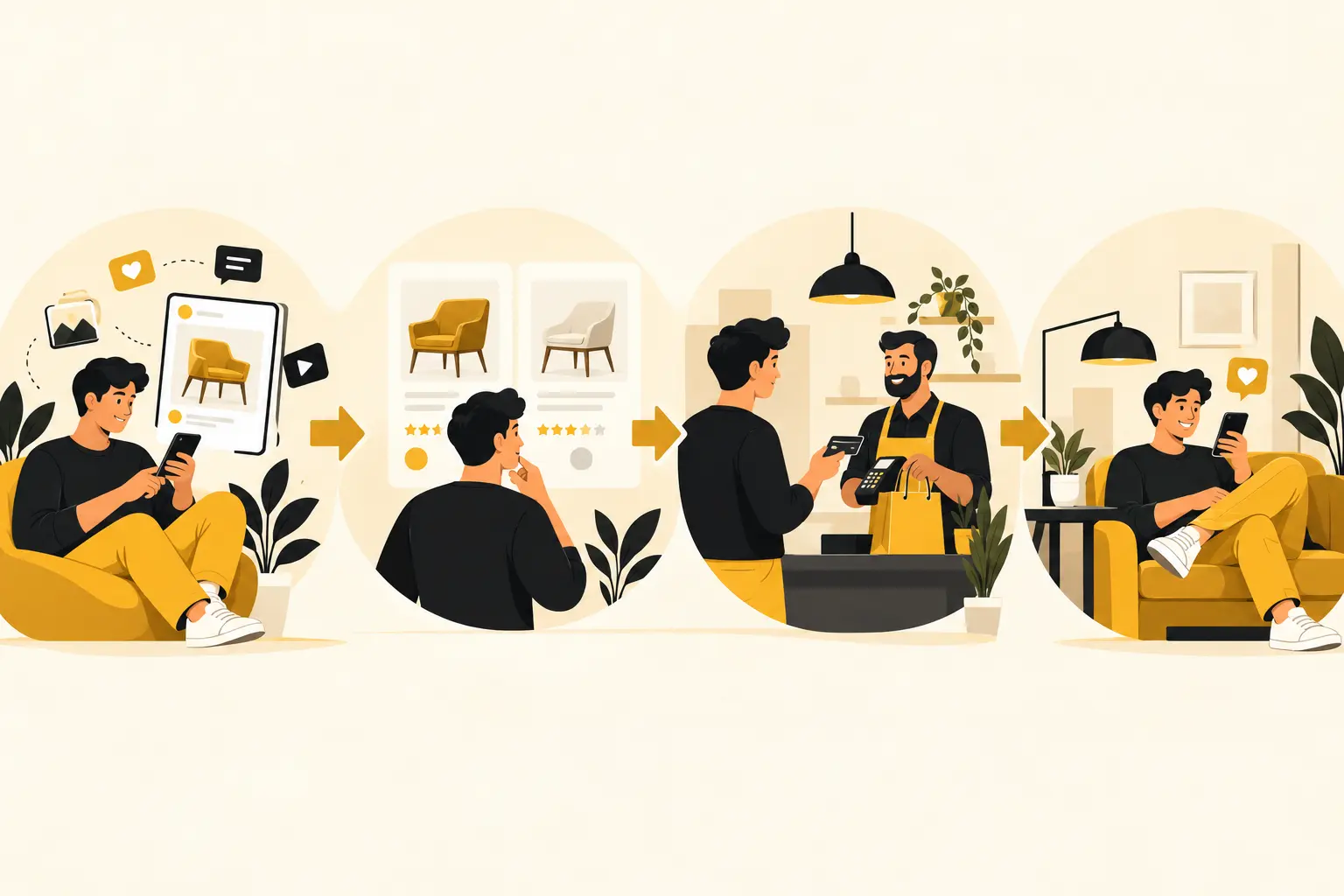
Here are the four stages in order, with what each one needs.
| Stage | Also called | What the customer thinks | What you do | What to track |
| Awareness | Top of funnel (TOFU) | “I have a problem” or “Who are you?” | Show up where they look: search, social media, ads | Reach and website visits |
| Consideration | Middle of funnel (MOFU) | “Which option suits me?” | Answer questions and show proof, like reviews and demos | Leads and cost per lead |
| Conversion | Bottom of funnel (BOFU) | “I’m ready to buy” | Make buying easy with a clear offer and a fast reply | Conversion rate and cost per sale |
| Retention | Bottom of funnel, looping back | “Was that worth it?” | Stay in touch and ask for reviews and referrals | Repeat orders and referrals |
The order never changes: awareness, consideration, conversion, then retention. The sale itself happens at conversion, at the bottom of the funnel. Retention comes after it, and it feeds the top again, because happy customers tell others.
Social media is a quick way to reach new people at the top, especially for local shops. Our guide on why social media marketing is powerful for local businesses shows how.
Why do guides list 3, 4, 5 or even 6 stages?
Open three guides and you’ll see three different counts. They describe the same path with more or less detail.
| Model | Stages | How it maps to ours |
| Three-stage | TOFU, MOFU, BOFU | Awareness, consideration, conversion |
| AIDA (four) | Awareness, interest, desire, action | Interest and desire sit in consideration, and action is conversion |
| Five-stage | Awareness, consideration, conversion, loyalty, advocacy | Loyalty and advocacy make up retention |
| Six-stage | Awareness, interest, consideration, intent, purchase, loyalty (one version) | Interest and intent split our consideration stage |
We use four stages because four are enough to act on. More stages add detail, but they rarely change what you do.
How a funnel works: a worked example

Back to our coaching institute. Here are its numbers for one month.
| Stage | People | Moved forward |
| Awareness: website visitors | 1,000 | Starting point |
| Consideration: enquiries by WhatsApp or form | 80 | 8% of visitors |
| Conversion: admissions | 6 | 7.5% of enquiries |
These numbers are an illustration, not a benchmark. Your rates will differ, and we skip industry averages on purpose because they vary too much between businesses.
So where did the 994 go? Most left before enquiring, and that’s normal. The 74 who enquired and didn’t join matter more, because they already wanted what the institute sells. Maybe the reply took a day, or nobody offered a demo class. Fix that stage so admissions rise from 7.5% to 15%, and the institute gets 12 admissions from the same 1,000 visitors. To get 12 by adding visitors alone, it would need about 2,000. That’s why we say fix the bottom before you buy more top.
Marketing funnel examples

Here’s how the same four stages look in three Sri Ganganagar businesses.
| Business | Awareness | Consideration | Conversion | Retention |
| Coaching institute | A parent sees a results Reel or searches for coaching nearby | Reads results, asks on WhatsApp, attends a demo class | Pays the admission fee | Sends progress updates and asks for referrals |
| Tractor dealer | A farmer searches for a new tractor model | Compares models on a landing page and calls | Books a test drive and orders | Sends service reminders |
| Sweet shop | A festival Reel and a Google Business Profile | Checks reviews and the menu | Orders on WhatsApp | Messages past customers before the next festival |
AI search now answers many of those first questions, so clear business details matter more than before. Our guide to AI for SEO in Sri Ganganagar covers it.
Marketing funnel vs sales funnel
People use the two terms loosely, but they start and stop in different places. A marketing funnel runs from first contact to a qualified lead, someone who has shown real interest. A sales funnel starts at that lead and runs to the close. Big companies hand the lead from a marketing team to a sales team. In a small business, the owner often does both, so the two funnels blur into one. That works fine. Just remember that a lead isn’t a sale until someone follows up.
Which digital marketing pillar helps at each stage?
Each stage leans on different pillars of digital marketing. Our guide to the pillars of digital marketing explains each one.
| Stage | Pillars that help |
| Awareness | SEO, social media, paid ads, content |
| Consideration | Content, email |
| Conversion | Paid ads, email, a clear landing page |
| Retention | Email, social media |
| Every stage | Analytics |
How to create a marketing funnel
You don’t need software to start. A notebook or a simple sheet works. Follow five steps:
- Pick one goal. For example, 20 new admissions or 30 orders a month.
- Know your customer. Who are they, and where do they look first?
- Map the stages. Write down what they ask at each stage and which offer, page or message answers it.
- Choose one or two channels per stage. Use the table above. A social media calendar keeps your posting steady.
- Count and fix weekly. Track the people at each stage, then work on the weakest one first.
FAQ
What does funnel mean in marketing?
A funnel is the path people take from first hearing about you to buying. It narrows because fewer people move forward at each stage.
What is a funnel in digital marketing?
It’s the same path tracked online, so you can count visits, leads and sales at every stage.
What are the 5 stages of the sales funnel?
Most guides use awareness, interest, consideration, conversion and loyalty. The names vary, but they match our four stages, with interest folded into consideration.
What is an example of a marketing funnel?
A parent sees a coaching institute’s Reel, asks questions on WhatsApp, attends a demo class, joins and later refers a friend.
At what stage does a sale happen in a marketing funnel?
At conversion, near the bottom of the funnel.