
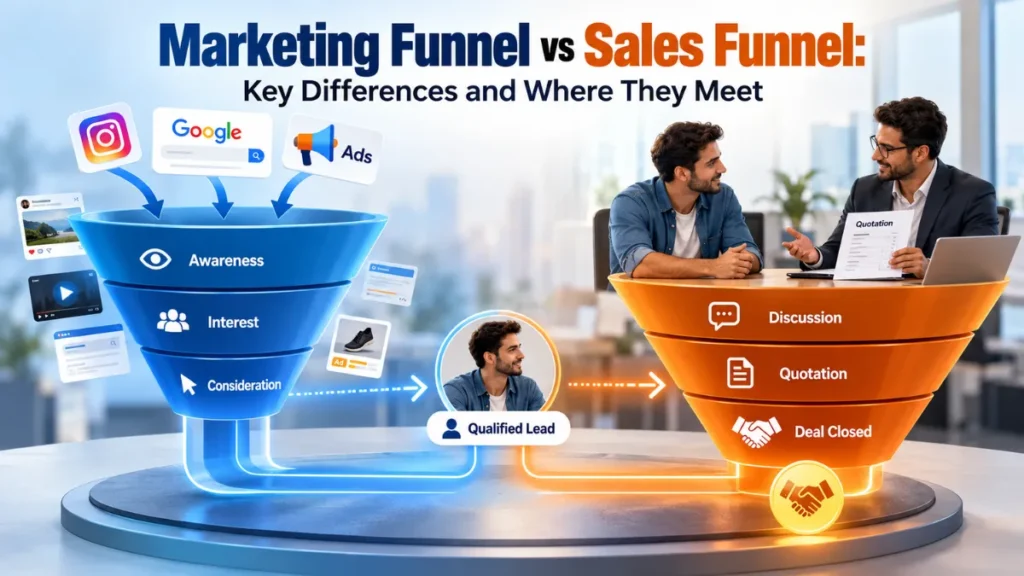
The marketing funnel takes a stranger to a qualified lead. The sales funnel takes that lead to a paying customer. Marketing works at scale through content, search and ads. Sales works one to one on price, trust and the close. In a small business, the owner often runs both, so the handoff point matters most.
What is the difference between a marketing funnel and a sales funnel?
Think of a relay race. The marketing funnel runs the first leg, and the sales funnel runs the last. The baton is a lead who wants something specific from you.
The marketing funnel starts when a stranger first sees your name. That might happen through a Reel, a Google search or a board outside your shop. It ends once that person raises a hand: they ask for a price, book a demo or message you on WhatsApp.
The sales funnel starts at that hand-raise. Here you talk to one person, answer their doubts, give a quote and ask for the order. It ends with a sale, or with a clear reason why you lost it.
However, guides disagree on where one funnel stops and the other starts. Some place the sales funnel inside the marketing funnel, and others place it after. We use the second view because it matches how work changes hands in a real business. Our guide to what a funnel in marketing is covers the stages in detail, so this article stays on the comparison.
Marketing funnel vs sales funnel: side by side
This table shows the gap at a glance.
| Marketing funnel | Sales funnel | |
| Starts with | A stranger who has never heard of you | A lead who asked you for something |
| Ends with | A qualified lead | A paying customer, or a lost deal |
| Main goal | Awareness, trust and enquiries | Orders and revenue |
| Who works it | A marketer, or the owner with a phone camera | A salesperson, or the owner on a call |
| How you talk | To many people at once | To one person at a time |
| Typical channels | Search, social media, ads, email, content | Calls, WhatsApp chats, demos, visits, quotes |
| What you track | Reach, clicks, cost per lead | Lead-to-sale rate, deal size, lost deals |
| Tools | Analytics, social platforms, landing pages | A CRM or a shared sheet |
Notice the pattern. Marketing counts people, while sales counts conversations. That difference decides which numbers deserve your attention. Our guide to the pillars of digital marketing lists the channels that feed the left column. Calls and visits sit outside those pillars, which explains why many digital plans stop at the enquiry.
Where does the marketing funnel end?
Your marketing funnel ends at a qualified lead. A qualified lead is someone who shows real buying intent, such as asking for a price, a demo, a call or a visit. Large teams call this person a marketing qualified lead (MQL). Once a salesperson accepts that lead, it becomes a sales qualified lead (SQL).
Small businesses can skip the jargon and use one rule: if a person asked you for something, sales owns them now.
That rule sounds simple, yet most leaks start right here. For example, a parent fills in an enquiry form on Monday, and nobody calls until Thursday. By then, the parent has spoken to two other institutes. So set a reply time, such as the same day, and treat it as a promise.
Likewise, track the handoff as its own number. Count the enquiries that arrive, then count the ones you answer within a day. That pair of numbers shows whether marketing’s work ever reaches sales.
A tractor dealer who fixed the wrong funnel
Picture a tractor dealer in Sri Ganganagar. These numbers are invented to show the logic, not to set a benchmark.
Every month, his Facebook videos and Google listing bring in 40 enquiries, and he sells 3 tractors. He decides he needs more traffic, so he doubles his ad budget. Enquiries rise to 80, yet he still sells only 3 or 4.
Then he checks his calls. Farmers who enquired on Monday heard back on Wednesday, and nobody sent a price list or offered a test drive. Meanwhile, several of those farmers had already visited another showroom.
So he changes three habits. He calls within a few hours, he sends the price list on WhatsApp straight away, and he books the test drive before the call ends. The next month, the same 80 enquiries turn into 7 sales. The fix costs him a phone habit instead of a bigger budget.
Which funnel was broken? The sales funnel. The marketing funnel worked from day one, and local shops often win their first enquiries that way. Our post on social media marketing for local businesses explains why.
The surprise: your customer never sees two funnels
Most guides treat the two funnels as separate machines. Your customer would disagree. A farmer who watches your video, calls the showroom and tests a tractor has one continuous conversation with one business. He never thinks, “I just left marketing and entered sales.”
The split exists for you, not for him. It tells you who owns each job and which number to check. In a local shop, the owner usually owns both jobs, so nobody else notices when the baton drops.
This idea also challenges the usual advice to fill the top of the funnel first. Ads feel like action, so owners buy more of them. However, the dealer above gained more from a phone habit than from a bigger budget. Before you spend another rupee on reach, check the bottom of the funnel. It often holds the cheaper win.
Which funnel does your business need?
Every business runs both funnels, but the weight differs. This table shows where each type of local business should put its effort.
| Business | Type of sale | Lean on | Why |
| Sweet shop | Quick, low price, repeat | Marketing funnel | Festival Reels and a Google Business Profile bring people in, and WhatsApp orders close themselves |
| Tractor dealer | High price, call and visit | Sales funnel | Farmers compare options, consult family and want a test drive before paying |
| Coaching institute | Mid price, demo-led | Both | Results posts bring parents in, and a demo class with counselling closes the admission |
| Online course seller | Self-serve checkout | Marketing funnel | Most buyers pay without talking to anyone, so add a sales layer only for bulk buyers |
Larger companies sometimes run the two funnels in parallel. Self-serve buyers go through marketing alone, while big clients meet a sales team. A small business rarely needs that split, so a single combined view usually works.
Still weighing whether the effort pays off? Here is how digital marketing helps businesses grow.
Funnel, pipeline, flywheel, journey: what is the difference?
People mix up four terms, so here is each one in a line.
| Term | What it shows |
| Funnel | How many buyers move from step to step, and where they drop out. It watches the buyer. |
| Sales pipeline | The deals your team is working on, with their stage and value. It watches the seller. |
| Flywheel | A loop of attract, engage and delight, where happy customers bring the next round of leads. |
| Customer journey | Everything the buyer does and feels, including steps you never see. |
The funnel and the pipeline cause the most confusion. In practice, the funnel tells you what to fix, and the pipeline tells your salesperson what to do tomorrow. You can use the same stage names for both, but you read them differently.
A five-step handoff checklist
You need no software to start. A notebook or a Google Sheet works.
- Define a lead in one sentence. For example: “Someone who asked for a price, demo, call or visit.”
- Keep one shared sheet. Give every lead a name, a source and a date, so you see which channel brings buyers instead of browsers.
- Set a reply time and hold it. Aim for the same day, and aim for hours when the purchase is big.
- Record why you lose deals. Use four labels: price, timing, went elsewhere, no reply. Marketing then fixes the message, and sales fixes the follow-up.
- Count weekly. Write down enquiries, replies within a day and sales. Then fix the weakest number first.
Meanwhile, keep the top of the funnel steady while you repair the bottom. A social media calendar for 2026 keeps posts going without daily effort. The benefits of a social media calendar also explain why planning ahead protects your enquiries.
FAQ
What is the difference between a marketing funnel and a sales funnel?
The marketing funnel moves a stranger to a qualified lead through content, search and ads. The sales funnel moves that lead to a purchase through one-to-one conversations. Marketing counts people, and sales counts conversations.
Is the sales funnel part of the marketing funnel?
Sources disagree. We treat them as two stages of one journey: marketing comes first, sales comes second, and both share retention.
What are the stages of each funnel?
Marketing covers awareness and consideration. Sales covers enquiry, quote and close. Both share retention afterwards. See the four stages of the marketing funnel for the full breakdown.
Which comes first?
The marketing funnel. Nobody enquires about a business they have never met.
What is the difference between a sales funnel and a sales pipeline?
The funnel tracks how buyers progress and drop out. The pipeline tracks the deals your team works on and what each one is worth.
Does a small business need both?
Yes, in a light form. You still attract people and you still close them, even if one person does both jobs.
Your takeaway
Open a sheet today and count three numbers for the last month: enquiries, enquiries you answered within a day, and sales. If the second number looks low, fix your reply speed before you pay for another ad. Then repeat the count every week.